What is Artificial Intelligence? A Simple Guide (2026)
What is artificial intelligence? This plain-language guide explains AI simply, with real Kenyan examples. Learn how AI works, what it can do for your business, and how to get started today.
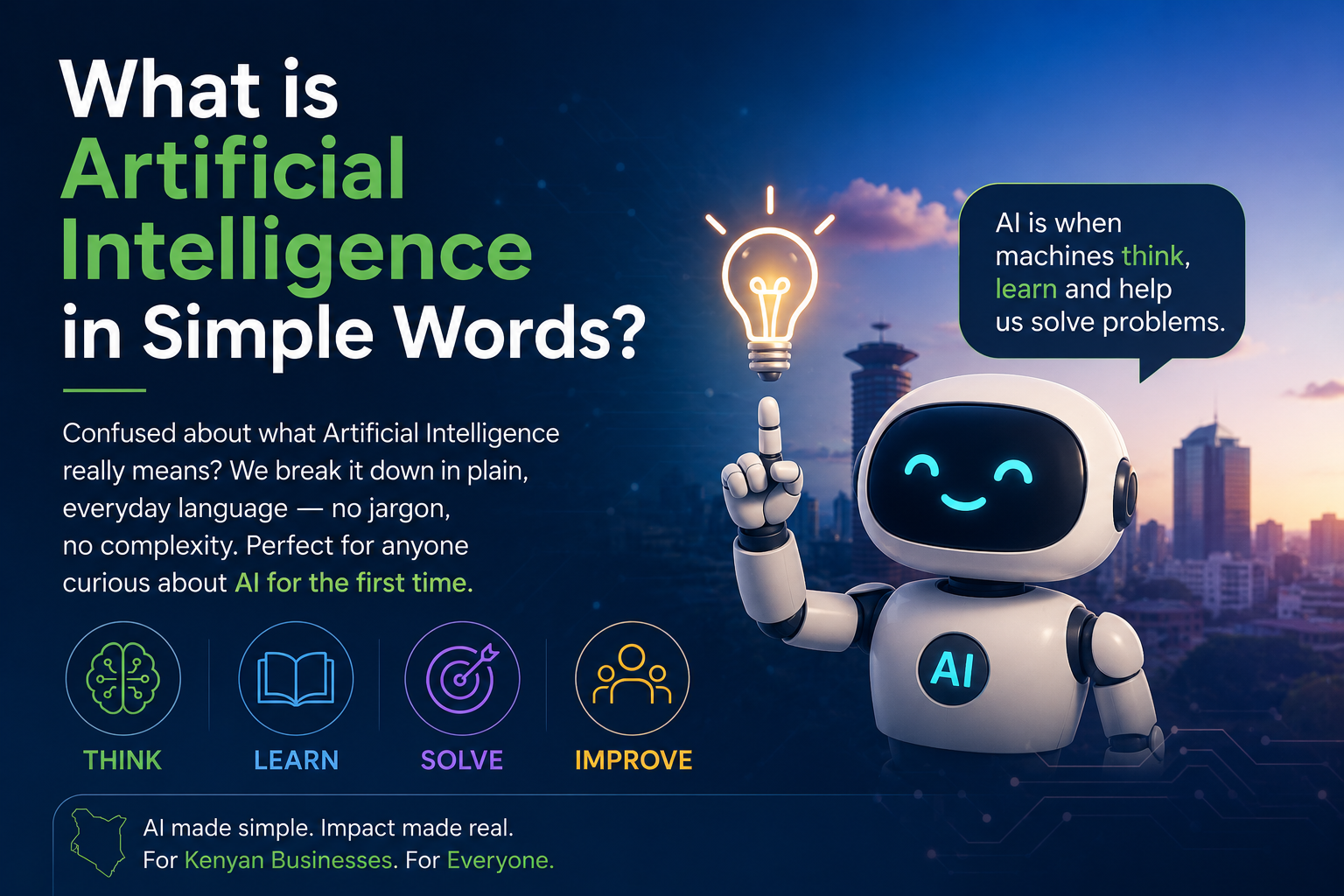
What is Artificial Intelligence? A Simple Guide (2026)
You have probably heard the term "Artificial Intelligence" or "AI" constantly in the past year — in the news, from colleagues, maybe from your bank or your phone. But what does it actually mean? And more importantly, what does it mean for you and your business in Kenya?
This guide explains everything in plain, everyday language. No complicated jargon. No tech-speak. Just clear, honest answers to the questions Kenyan business owners and professionals are actually asking. By the time you finish reading, you will have a solid understanding of AI — and a clear sense of what it could do for you.
The Simplest Possible Definition of AI
Imagine you hired an employee who:
That is essentially what Artificial Intelligence is — a computer program that can learn from experience and make decisions, much like a human being, but faster, more consistently, and at far greater scale.
In one sentence: Artificial Intelligence is technology that enables computers to perform tasks that normally require human thinking — like recognizing patterns, making decisions, understanding language, and predicting outcomes.
A Familiar Kenyan Example
You have used M-Pesa thousands of times. But have you ever thought about what happens in the background when your transaction goes through?
Every time you send money, an AI system analyzes dozens of variables simultaneously: the amount, the time of day, the location, the recipient, how this transaction compares to your normal patterns. If something seems unusual — for example, you normally transact in Nairobi but suddenly a transaction appears from a different city at 2am — the AI flags it or sends a verification request.
That instant, invisible decision is AI in action. It happened in milliseconds. A human team monitoring millions of daily M-Pesa transactions would be completely impossible — but AI does it effortlessly.
Here is another familiar example: when Netflix or YouTube suggests something to watch after you finish a video, that recommendation did not come from a person. It came from an AI that studied your viewing habits, compared them to millions of other users with similar tastes, and predicted what you would enjoy next. That prediction gets more accurate the more you use the service.
How Does AI Actually Work?
Think about how a child learns to recognize a dog.
At first, a parent shows the child a photo and says: "This is a dog." They show more photos — big dogs, tiny dogs, fluffy dogs, short-haired dogs — each time saying "dog." Gradually, the child's brain builds a mental model of what "dog" means. Eventually, they can recognize a dog they have never seen before, even a very unusual-looking one.
AI learns the same way, but instead of a handful of photos shown by a parent, the AI might analyze ten million images labeled "dog" and "not a dog." It finds the patterns that distinguish dogs from everything else, and encodes those patterns mathematically. This process is called Machine Learning — the AI learns from large amounts of labeled data until it can generalize to new situations accurately.
The more data the AI studies, and the better that data is organized, the smarter the AI becomes. This is why data is often called "the fuel of AI."
The Types of AI You Will Encounter
Narrow AI — What Exists Today
Every AI product you can use right now is what is called Narrow AI. It is extremely good at one specific task, but cannot do anything outside of what it was trained for.
Examples:
Narrow AI is not science fiction. It is a practical, proven technology that is actively transforming Kenyan businesses right now.
General AI — Still in Development
General AI would be a system that can do anything a human can do — reason about entirely new problems, transfer knowledge from one domain to another, create, plan, and adapt. This does not exist yet, but researchers are actively working toward it.
Superintelligent AI — Future Theory
This is the AI of movies and science fiction — a system smarter than all of humanity combined. This remains theoretical and is not a near-term concern for businesses.
For everything practical and relevant to your business today, Narrow AI is what matters.
AI You Are Already Using in Kenya Without Realizing It
You may be surprised how much AI is already woven into your daily life:
On your smartphone:
Online and in apps:
In financial services:
In business tools you may already use:
What AI Is NOT — Clearing Up the Myths
Myth 1: AI is going to take over everything and replace all jobs
Reality: AI replaces specific tasks, not entire professions. It handles the repetitive, data-heavy, time-consuming parts of jobs — freeing human beings to focus on strategy, creativity, relationships, and judgment. Many jobs will change significantly; new jobs focused on working with AI are already emerging.
Myth 2: AI is only for huge multinational companies
Reality: The cost of AI tools has dropped dramatically. Solutions that cost millions of dollars five years ago are now available as affordable monthly subscriptions. Kenyan SMEs with as few as 20 employees are successfully deploying AI today. Our team at Alpha AI Kenya specifically designs solutions scaled to Kenyan business realities.
Myth 3: You need a massive amount of data to use AI
Reality: Many AI solutions work well with the data a typical business already has. You do not need a data warehouse — your transaction records, customer database, and operational logs are often enough to start.
Myth 4: AI is always right
Reality: AI makes mistakes, especially when trained on incomplete or biased data. Good AI implementation always includes human oversight, quality monitoring, and regular retraining. No responsible AI company will promise you a perfect system.
Myth 5: AI is complicated and hard to use
Reality: Modern AI tools are increasingly designed for non-technical users. Many look and feel like the apps you already use every day. The complexity is under the hood — you do not need to understand it to benefit from it.
What AI Can Do for Your Kenyan Business Right Now
You do not need to understand the technical details of how AI works to start benefiting from it. What matters is understanding where it can solve real problems in your business.
If you struggle with customer service:
AI chatbots can handle common questions instantly, 24 hours a day, in English and Swahili — letting your team focus on complex, high-value interactions. See how our AI customer service solutions work.
If you waste time on repetitive tasks:
AI automation can handle data entry, report generation, invoice processing, and dozens of other routine tasks faster and more accurately than manual work — often at a fraction of the cost.
If you want to understand your customers better:
AI can analyze your sales data, website behavior, and customer history to reveal patterns you would never spot manually — which customers are likely to buy again, which are at risk of leaving, and what products to promote to whom.
If you are losing money to fraud or errors:
AI fraud detection and anomaly identification can catch problems in real-time that manual processes miss entirely.
If you want to grow faster:
AI-powered marketing personalization, demand forecasting, and business intelligence give you the insights to make smarter, faster decisions — with data rather than guesswork.
The Honest Truth About AI Adoption in Kenya
Implementing AI in your business is not magic, and it is not instant. Here is what it actually involves:
The businesses succeeding with AI in Kenya are not the ones that tried to do everything at once. They started with one clear problem, delivered a focused solution, proved the ROI, and then expanded. That approach works every time.
Frequently Asked Questions About AI
Q: Is AI the same as robots?
Not necessarily. Most AI has no physical form at all — it lives in software, running on computers. Some robots use AI to navigate or make decisions, but most AI applications are purely digital. When your bank's app detects fraud, that is AI — no robot involved.
Q: Can AI understand Swahili?
Yes. Modern language AI models are trained on dozens of languages including Swahili. Kenyan businesses are already deploying AI customer service that responds fluently in both English and Swahili, and even understands common Kenyan slang and Sheng.
Q: How much does AI cost for a small business in Kenya?
It varies enormously. Entry-level AI tools — like AI-powered customer service chatbots or basic automation — can start from as little as KES 20,000–50,000 per month. More comprehensive business intelligence or custom AI solutions require larger investments. Contact our team for honest pricing based on your specific needs.
Q: How quickly will I see results from AI?
For automation and customer service applications, measurable results typically appear within the first 30–60 days. More complex implementations like predictive analytics or fraud detection may take 2–4 months to demonstrate full impact as the system learns your data.
Q: What is the difference between AI and regular software?
Traditional software follows fixed rules that a programmer writes. AI learns its own rules from data. A traditional spam filter checks for specific keywords you define. An AI spam filter learns what spam looks like from millions of examples and keeps improving — catching new spam techniques its creators never explicitly programmed.
Q: Do I need to understand coding to use AI in my business?
No. Modern AI tools are designed to be used by business people, not programmers. If you work with an experienced implementation partner, you do not need any technical background. You focus on your business goals; we handle the technology.
Your First Step Into AI
If you have read this far, you understand the basics of what AI is and what it can do. The natural question now is: where do I start?
The answer depends on your business, your biggest challenges, and your current data situation. There is no single right answer that works for everyone. What we can tell you is that the best first step is always a conversation with someone who understands both AI and the Kenyan business landscape.
Alpha AI Kenya offers a free initial consultation where we listen to your business challenges, assess where AI could realistically help, and give you an honest picture of what implementation would involve — with no obligation.
Artificial intelligence is not going to remain a competitive advantage for early movers forever. It is becoming a baseline expectation. The businesses that figure it out now will be far better positioned than those who wait.
Start your AI journey with a free consultation today. We would love to help you find your first win.
Alpha AI Team
Alpha AI Kenya — Nairobi's leading AI solutions company
The Alpha AI Kenya team shares practical insights on artificial intelligence, machine learning, and digital transformation for businesses across Kenya and Africa. Learn more about us →
Ready to implement AI in your business?
Let Alpha AI Kenya help you identify and build the right AI solution. Free initial consultation — no commitment required.
Get Started Today